
Space
Discover the truths about God and Outer Space.
What is the Black Hole in Outer Space?
Welcome to myGospelHome.org! Today, we’re diving into one of the most fascinating topics in astrophysics: black holes. In this article, we will explore the sheer size of black holes in comparison to our home planet, Earth.
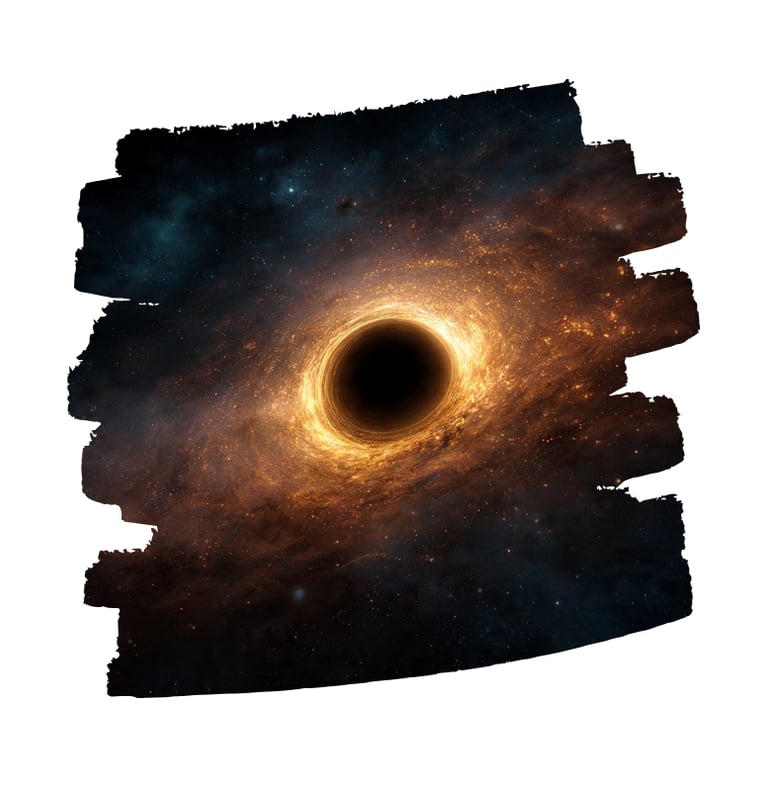
A black hole is a region in space where the gravitational pull is so strong that nothing, not even light, can escape from it. Black holes are formed when massive stars exhaust their nuclear fuel and collapse under their own gravity. This phenomenon results in a concentration of mass in an incredibly small area, leading to a point of infinite density known as a singularity.
To put things into perspective, consider the largest black hole currently known, which is part of the quasar 3C 273. This supermassive black hole has a mass equivalent to around 66 billion times that of our Sun. In comparison, Earth has a mass of about 5.97 x 10^24 kilograms. When we look at black holes in terms of volume rather than simply mass, things become even more astounding.
The sizes of black holes can vary dramatically. Stellar black holes, formed from collapsing stars, can range from about 3 to several tens of solar masses. Supermassive black holes, which reside at the centers of galaxies, can reach millions to billions of solar masses. If we compare these numbers, even the smallest supermassive black hole far exceeds Earth's size.
If you envision the event horizon—the boundary surrounding a black hole beyond which nothing can escape—supermassive black holes can have event horizons that stretch across vast distances. For instance, the event horizon of the supermassive black hole at the center of the Milky Way galaxy, known as Sagittarius A*, is approximately 44 million kilometers in diameter. In contrast, Earth's diameter is about 12,742 kilometers.
In conclusion, black holes are significantly larger than Earth, both in terms of mass and the scale of their event horizons. While the exact sizes can vary widely depending on the type of black hole, one thing remains clear: the comparison emphasizes just how extraordinary the universe is and how much more there is to learn about its wonders.
The Black Hole in Outer Space: The Energy of God
In the vast expanses of outer space, one of the most intriguing phenomena is the black hole. These enigmatic regions, known for their immense gravitational pull and mysterious nature, have captured the attention of scientists, philosophers, and spiritual thinkers alike. Some propose that black holes represent more than just astrophysical objects; they may embody the very energy of God.
Understanding Black Holes
A black hole is formed when a massive star exhausts its nuclear fuel and collapses under its own gravity. The result is an area in space where the gravitational field is so strong that nothing, not even light, can escape from it. This characteristic leads to the dark appearance of black holes, which can be found at the centers of galaxies or formed through the collapse of individual stars. Scientists classify black holes into several categories, including stellar black holes, supermassive black holes, and intermediate black holes, each varying in size and origin.
The Connection to Divine Energy
The notion of black holes as the energy of God is a metaphorical interpretation that invites deeper contemplation on life, existence, and the universe. From a spiritual perspective, some argue that the intense energy and gravitational forces of black holes can be seen as a manifestation of divine power. This perspective suggests that the same forces that govern cosmic phenomena also connect to a higher intelligence or creative force often associated with the concept of God.
Just as black holes absorb all matter surrounding them, one could extrapolate that divine energy encompasses all existence, drawing together the disparate elements of life and creation. Moreover, the mysterious nature of black holes reflects the unknown aspects of spirituality and the infinite possibilities of a higher power that often defy human understanding.
The Intersection of Science and Spirituality
The intersection of science and spirituality regarding black holes fosters a unique dialogue about our universe's nature. While science seeks to explain the mechanics and theories behind black holes through empirical data and mathematical models, spirituality often focuses on the philosophical implications of existence and the essence of consciousness. This dialogue suggests that there is room for both scientific inquiry and spiritual interpretation, allowing individuals to explore their beliefs about the origins and complexities of the universe.
As we continue to study black holes through advanced scientific methods, we are reminded of the greater mysteries that lie beyond our comprehension. The discussion surrounding black holes as the energy of God encourages us to ponder the larger questions of life, purpose, and creation.
In conclusion, while black holes are scientifically defined entities within the framework of astrophysics, viewing them as a representation of the energy of God invites a profound exploration of existence itself. As humanity continues to pursue knowledge about the cosmos, the blending of scientific insight and spiritual reflection may lead to a more holistic understanding of our place in the universe.
Genesis 1-5
1) In the beginning God created the heaven and the earth.
2) And the earth was without form, and void; and darkness was upon the face of the deep. And the Spirit of God moved upon the face of the waters.
3) And God said, Let there be light: and there was light.
4) And God saw the light, that it was good: and God divided the light from the darkness.
5) And God called the light Day, and the darkness he called Night. And the evening and the morning were the first day.
(KJV)
Does the Sun Create Storms?
The relationship between the Sun and Earth's weather systems is complex and fascinating. While the Sun creates solar storms, it plays a vital role in the processes that lead to storm formation on Earth.
The Sun is the primary source of energy for our planet. Its energy drives atmospheric circulation, influencing weather patterns and conditions. This energy heats the Earth's surface unevenly, causing variations in temperature and pressure. These variations are fundamental to the formation of wind and can lead to different weather phenomena, including storms.
Solar activity, such as sunspots, solar flares, and coronal mass ejections, can affect space weather, which in turn can have some impact on Earth's atmosphere. For instance, strong solar storms can disrupt satellite communications and affect power grids.
In the realm of meteorology, storms are primarily driven by atmospheric conditions such as temperature, humidity, and pressure systems. Thunderstorms, hurricanes, and tornadoes are all a result of these atmospheric dynamics.
In summary, while the Sun creates solar storms, it is an essential factor in the broader climate system that can influence weather patterns and indirectly contribute to storm development. Understanding this relationship is crucial for predicting weather and mitigating the impacts of severe weather events.
Nahum 1:3
The LORD is slow to anger, and great in power, and will not at all acquit the wicked: the LORD hath his way in the whirlwind and in the storm, and the clouds are the dust of his feet.
(KJV)
What are Solar Storms?
Solar storms, also known as solar flares or coronal mass ejections (CMEs), are significant disturbances on the sun that can have far-reaching effects on Earth. Understanding these cosmic events is crucial for individuals and communities, especially when it comes to technology and communication.
What Causes Solar Storms?
Solar storms are caused by the sun's magnetic field, which can become unstable and release massive bursts of energy. These events occur frequently, but their intensity can vary dramatically. During periods of high solar activity, such as solar max, the chances for stronger storms increase.
Effects of Solar Storms on Earth
When a solar storm occurs, it sends charged particles streaming toward Earth. This influx can have several effects, including:
Geomagnetic Storms
These storms can disrupt the Earth's magnetic field.
Effects on Technology
Satellites may experience disruptions, GPS accuracy can diminish, and power grids can be affected, leading to potential outages.
Auroras
One of the most beautiful consequences of solar storms is the enhancement of auroras, like the Northern and Southern Lights, which are caused by charged particles interacting with the Earth's atmosphere.
Preparing for Solar Storms
Communities and individuals can take several steps to prepare for potential impacts from solar storms:
Stay Informed: Follow updates on solar activity from trusted sources.
Have a Plan: Prepare for possible disruptions in power or communication.
Protect Technology: Consider surge protectors for sensitive devices.
Understanding solar storms is essential for everyone, as their effects can ripple through modern technology and infrastructure.
John 8:12
Then spake Jesus again unto them, saying, I am the light of the world: he that followeth me shall not walk in darkness, but shall have the light of life.
(KJV)
Is it Possible That God is in Outer Space?
The concept of God residing in outer space is a topic that has sparked curiosity and debate across various cultures and belief systems. While traditional views often depict God as an omnipresent, omnipotent being, the idea of a divine presence among the stars challenges these perceptions and invites a broader exploration of spirituality and the cosmos.
Many theologians and philosophers have pondered the relationship between God and the universe. For some, the vastness of space serves as a reminder of the grandeur and mystery of the divine. The sheer scale of the universe—with its billions of galaxies and countless celestial bodies—can lead believers to contemplate whether God exists in the galaxies far beyond our own.
On a scientific level, the search for extraterrestrial life has prompted discussions about the possibility of divine beings or forces influencing life forms in other regions of the universe. The question of whether God could interact with or be present in distant nations, planets, or forms of life remains an open field for speculation.
Furthermore, various religious texts paint different pictures of God's relationship with creation. In some interpretations, God is thought to transcend physical form, suggesting that the divine could inhabit all spaces, including the vast expanse of outer space. Others believe that God is intimately involved in the universe's workings, guiding and overseeing the laws of physics and nature.
The exploration of outer space also raises philosophical inquiries regarding the nature of existence, purpose, and the universe itself. If intelligent life were to be discovered beyond Earth, it could prompt questions about God's role in those lives and what that means for humanity's understanding of faith and existence.
Ultimately, the question of whether God is in outer space may lead to more questions than answers. It invites each individual to explore their beliefs, expanding the dialogue between science, spirituality, and the unknown mysteries of the universe. As we continue to venture into the cosmos, we may find that the search for understanding both our origin and our ultimate place in the universe is a journey that intertwines the earthly with the divine.
2 Corinthians 4:4
In whom the god of this world hath blinded the minds of them which believe not, lest the light of the glorious gospel of Christ, who is the image of God, should shine unto them.
(KJV)
Thank you for visiting myGospelHome.org! We hope this article has provided a clearer understanding of the vastness of outerspace compared to God in the Bible. Stay tuned for more informative content! If you have any questions or comments, feel free to reach out.
Connect
Need help with anything?
Email me
Resources
Subscribe
myGoseplHome © 2026. All rights reserved.